BLKBRD Shoes Review | The Relevance & Modernity.
Boots has kept BLKBRD in headlines. I, however, had the chance to see how their shoes manage to both honor tradition and bend it.
July 5, 2026
Thriving in a niche market consequently tempts business owners to broaden their horizons. However, Purists who defy such conventional corporate logic and remain true to themselves bring genuine integrity to the product.
Such makers don’t appear cynical by comparison but look passionate. Admittedly, even within such micro-demographics, they accentuate one aspect and minimise another. Every maker has its heritage, thus presents something different.
They all make cars, for instance, but one goes to Ferrari for a reason. The same principle applies to bootmakers and shoemakers. A pair of Bridlen boots speaks to sophistication, just as a Craft & Glory Oxford champions robustness, and a BLKBRD Derby radiates strength.
Look at the imagery a maker is pulling out and purchase accordingly. While it demands some upfront research, the payoff is a genuinely satisfying choice. On those grounds, you are far more likely to secure a truly compelling pair of boots from BLKBRD.
My journey with the brand began in 2022 when I saved up for my first pair. I’ve since acquired two more pairs of BLKBRD boots, and I detail my complete experience with all three in a separate post.
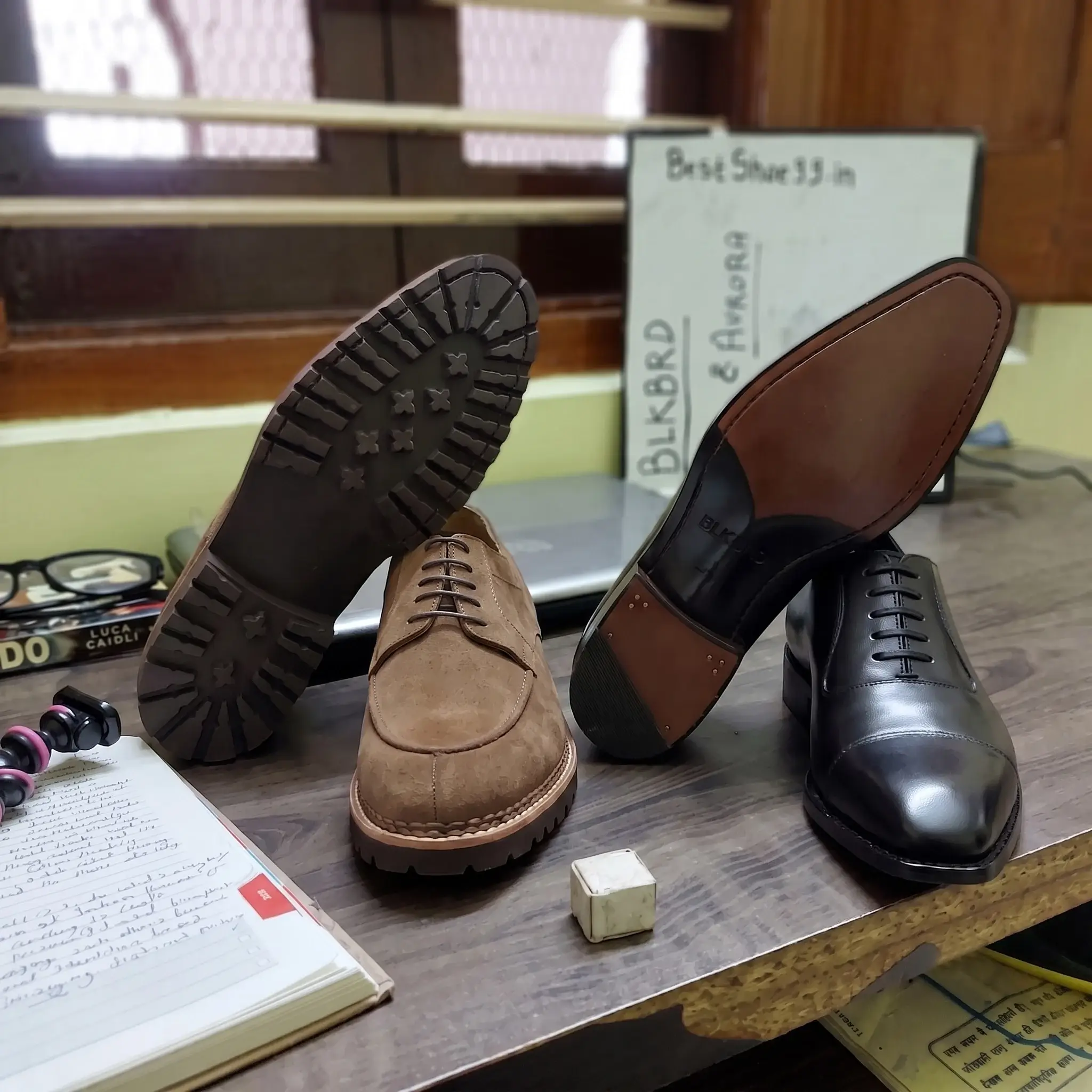
But when BLKBRD very kindly offered me a pair, I jumped at the chance, but I was rather experimental. I opted for the Adele Oxford and the Aurora Derby to explore the unacknowledged side of BLKBRD—treating them as an experimental gamble I probably wouldn’t have taken if I were paying out of pocket.
Those are indeed a level up from most of the Indian shoemakers’ dress shoes, particularly in terms of benchmakers like make, material, and design. But how can one speak about any shoemaker’s formal domain without benchmarking it against the best of Bridlen?
The price difference is primarily reflected in the quality of the leather and the shape of the shoes. In this reading, I’ve mentioned all my thoughts, findings, things I (don’t) like, the next best upgrade, and everything one could find useful from my last eighteen months with these BLKBRDs.
The Leather
The full-grain leather & split suede manage to give the expected appearance and strength.
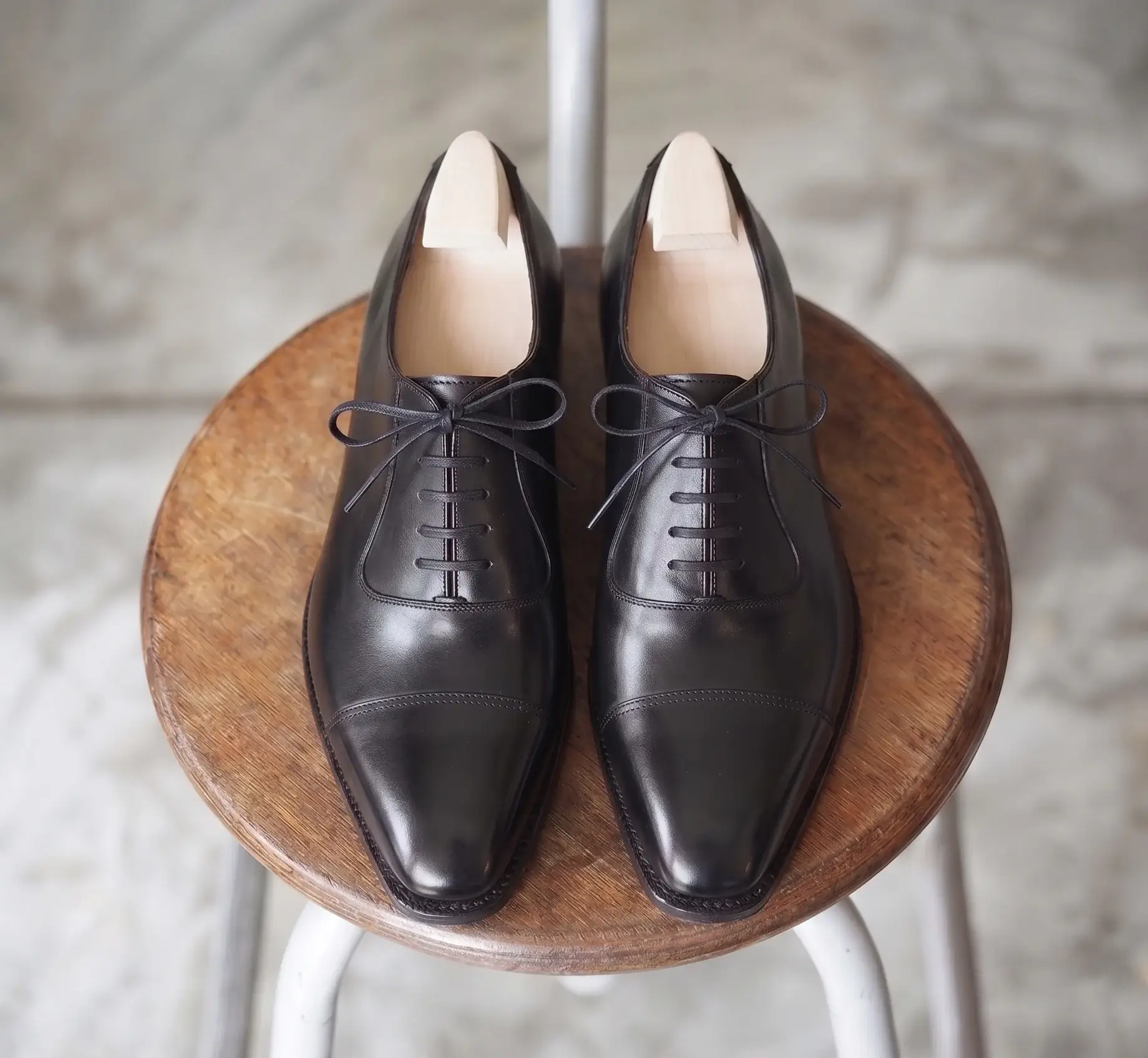
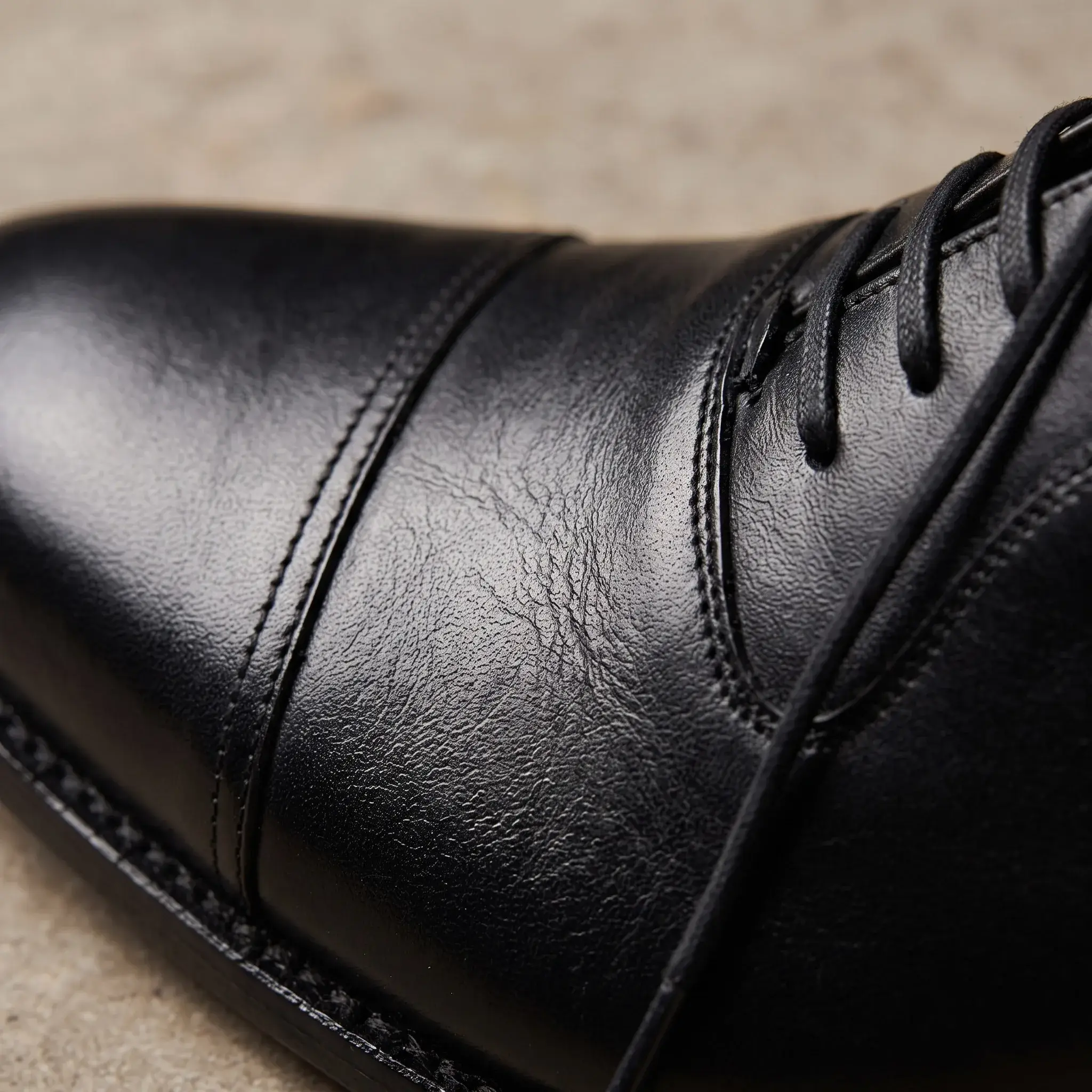
The Adele Oxford illustrates a surprisingly smooth full-grain (like cold-weather calf) leather upper; surprisingly, because finding untrimmed leather with such a remarkably tight grain structure is incredibly rare at this price point.
That one characteristic opens up a swath of positives on how this leather will look and age. The tight-and-fine-grain structure means they drape and have a sharpness that clearly separates them from most like-priced materials, even if they are also full-grain leather.
This leather folds into hair-thin micro-creases, which relax beautifully with routine rotation and proper care. This tightly interwoven grain also guarantees much better shape retention.
Such aesthetic distinctions are paramount on formal silhouettes, where the clean lines of an Oxford demand nothing less than a flawless grain.
Although I won’t delve into the background of this leather (plenty of information on that can be found here), it is relevant to note that this dense, tight-grained structure is characteristic of animals native to colder environments.
To trap body heat, their skin develops a tight, close-grained fiber structure, rather than the open pores that help tropical animals release heat.
The grain structure aside, there remain a handful of characteristics that define a truly world-class leather, and this leather happens to lack them. It lacks the depth that a deeply penetrated (by dying agents) leather produces.
It has a flat, rather two-dimensional finish, which might be susceptible to wear. It counts on a deep, reliable drum-dyed base to produce a decent business-appropriate finish. The nuances this leather lacks don’t make it bad, but keep it from being great.
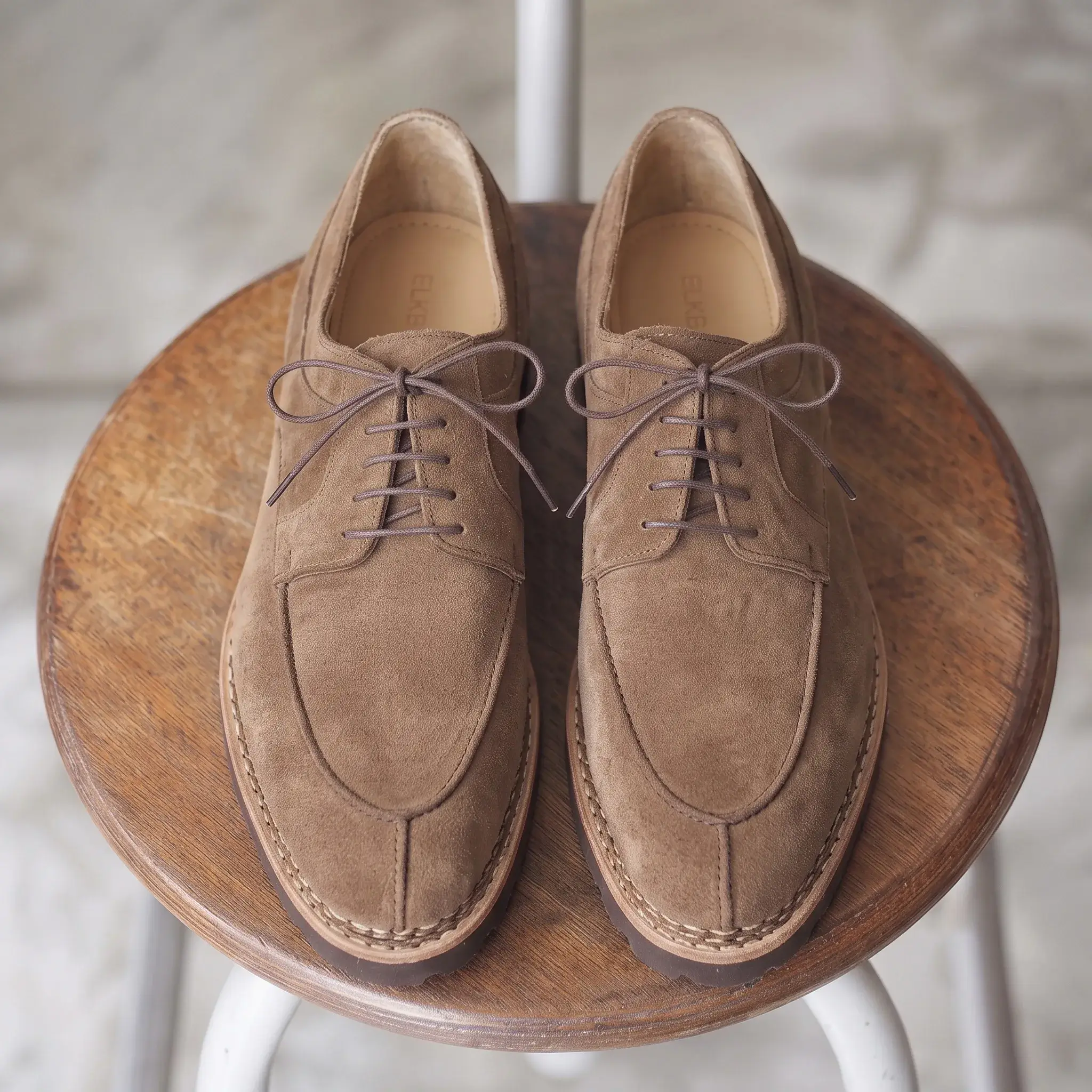
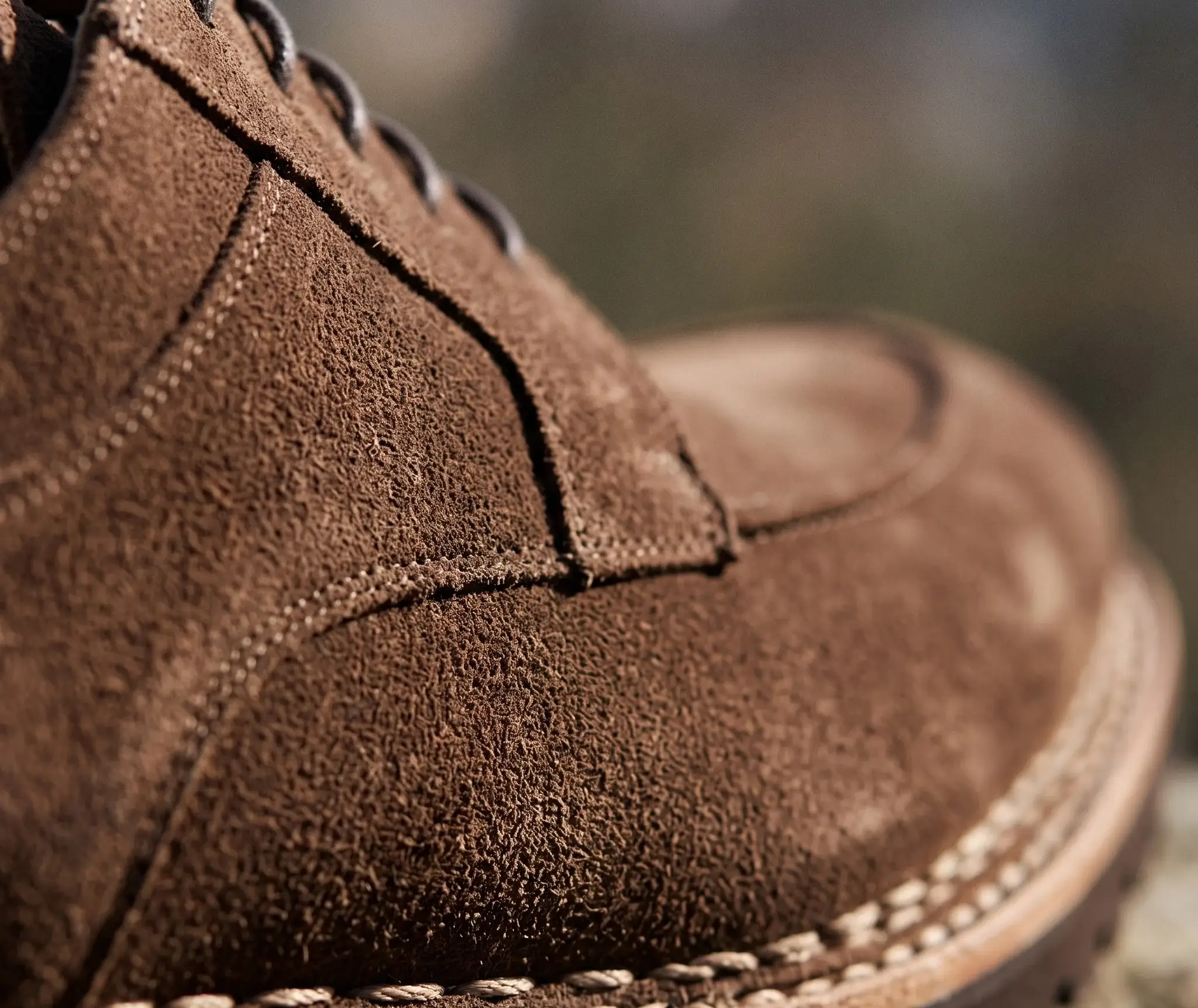
My second pair from BLKBRD—the Aurora Derby—is crafted in suede. It’s an incredibly forgiving material; because it utilizes the flesh side of the hide, there is no surface grain to reveal scars or develop unsightly creasing.
Because the texture completely absorbs any creasing or wrinkling from daily wear, the nap lends this suede a rich, uniformly matte appearance. But that is the visage that has surrounded suede.
Beneath the surface lie several objective metrics for measuring suede quality, which primarily affect the material’s strength and feel. The material used for my Aurora Derby is split suede—the most common type available.
It is crafted from the rough, fibrous underside of the hide that remains after the top layer of full-grain leather has been split away. It is neither water-resistant nor has a prolonged life. At the risk of sounding blunt, this is a byproduct that has been turned into an attractive, sellable item thanks to some clever finishing.
The gold standard in the suede domain is the unsplit hide, where the tough grain side faces the interior of the shoe while the raw flesh side faces outward. My Kozasko Chukka boots perfectly demonstrate the potential of this superior quality suede.
What lies behind & beneath these?
The Calf leather lining, veg-tanned leather (and light Vibram Genepy) outsole: becomes comfortable but remains tough.
The upper leather is the see-and-be-seen kind of contributor. Rest is more personal, especially the lining and sole. These are often the first areas a maker will look to trim production costs—whether by switching to cheaper material, partial lining, or, adversely, by eliminating.
However, due to the higher price point, BLKBRD has the freedom to use high-quality materials in these hidden yet vital areas. Both shoes come with drum-dyed calf leather lining covering the entire interior.
Their deemed benefits should be enhanced breathability and strength. However, a contradiction arises: the fabric boards are glued for better shape retention at the cost of reduced breathability.
The thorough seamless wrap, the tendency to mold, and the additional support are, I felt, noticeable pluses of having such a costly full-leather lining. The deep penetration achieved by drum-dyeing the leather protects the lining from any odd discoloration.
On the Aurora Derby, the stiffness of the full leather lining counteracts the “floppiness” of split suede. This prevents the derby from developing unsightly wrinkles, sagging, and losing its shape over time.
Set against the smooth leather lining, a suede piece on the heel counter acts like a mild brake, gripping the sock fabric and locking the heel firmly down into the heel cup even without tight lacing.
This suede arrangement pairs perfectly with the very rigid sole unit, which otherwise resists bending and forces the heel out of the shoe.
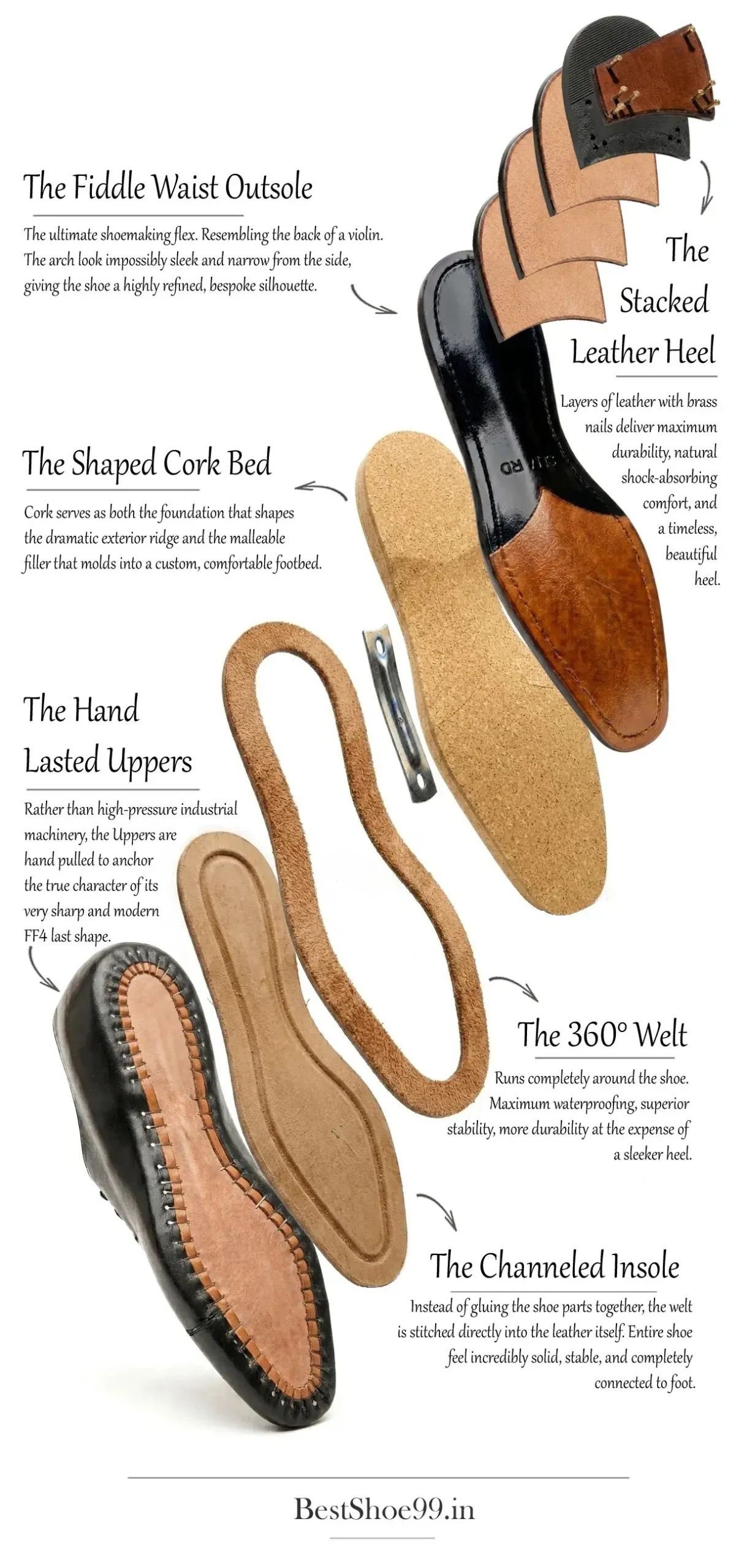
Both shoes are built on a traditional sole construction: the Adele features an Italian veg-tanned leather outsole with a fiddleback waist that matches its Oxford cosmetics, whereas the Aurora Derby comes with a cleated Vibram Genepy outsole—balancing city street articulation with Norwegian construction.
The veg-tanned Italian leather outsole is both functional and flattering. The very tight fibre structure of European Bovine renders a relatively flexible outsole despite the density and veg-tanning: a traditional but slow process where hides are turned into stiff and strong leather using natural tannins.
It’s the pliability that makes the renowned fiddleback waist possible. Of course, no one will ever actually see it—unless you’re in the habit of sitting cross-legged.
I prefer an elegant-looking outsole material that snaps back smoothly when walking, but not at the cost of tear strength—a quality that separates Italian leather soles from vegetable-tanned buffalo leather soles.
I agree, it feels too stiff for people to have a buffalo leather outsole, but one gets used to it surprisingly quickly. The Aurora Derby’s Vibram Genepy outsole is good in aspects that many people need the most.
Vibram engineers have worked on the compound to disguise the weight usually associated with such high-durability, high-traction outsoles.
It is often claimed that this sole has a little bit of rebound, which I didn’t notice, but would admit that it is surprisingly lightweight for what its strength and cleated lugs suggest.
Both shoes come standard with a thick leather insole. That thickness is celebrated, at least in part, as it is a much more reliable platform to reserve a foot impression, and can withstand more resoles as well.
The real highlight here is what a thick leather insole brings to the specific type of sole construction these shoes are built upon.
The Make
The functional handwork turns out a lot better than rivals costing three times as much.
No matter what type of leather it’s fitted with, the true mark of quality for a ₹13k dress shoe is its ability to stay comfortable and pristine for years. BLKBRD, in my opinion, has delivered on that crucial aspect quite competently by leveraging the nation’s lower cost of living to hire elite talent.
The ‘handmade’ label does not sway me impulsively; in fact, I would opt for it if something is better-made by a machine. However, what BLKBRD harbours is functional handwork, which, here, becomes the difference between a good shoe and a great shoe.
Why should one get excited by this “Hand-welted” thing?
Because it possesses poise, performance, and feel that surpass what machine-welting can achieve.
Both shoes have a very compact construction (which results in a very responsive and connected feel), and that can only be achieved when the construction is hand-executed.
Having the layers of sole attached by hand enables intense hammering and pressing, producing a perfectly dense, void-free unit. A lot of the attributes I’m trying to convey are best illustrated through the Adele Oxford, as it is built on the familiar welted construction.
Running a lockstitch through the upper, insole, and welt, while an entirely separate stitch is used to attach the outsole: this dual-stitch reinforcement is all it takes to tag the pair as Goodyear-welted. Thus, it has enough room for smart sacrifices, and the maker’s intent matters.
BLKBRD can put meticulous handwork; therefore, their welting remains remarkably faithful to the traditional, pre-machine era of Goodyear-shoemaking.
The welt is sewn to a thicker leather insole (not to a canvas rib glued to a thin insole leather, as machines need something to grab onto); for this reason, the sole unit feels integrated into the shoe’s structure.
And because there’s no raised canvas rib, a very thin void is left for cork filling. It’s an advantage to have a leather-dominant (over a cork-dominant) footbed because of leather’s structural integrity and shape-retention tendency.
Indeed, the cork-rich sole unit takes the shape of the foot quickly, but it does so through compression, which, under prolonged wear and over compression, squishes too thin and bottoms out.
The thick leather insole, in this case, molds through displacement and fiber shifting. Collapses slightly under a high-pressure zone (like the heel and ball of the foot) while rising to support the arch and then hardens into a permanent, rigid “cradle” that never sags or flattens out.
Then the wonderful thing is the feel. Because hand-welting minimizes filler and eliminates synthetic components like glue and canvas rib entirely, the shoe feels less like a heavy platform bolted to the foot and more like an extension of the foot.
What’s that Norwegian construction?
It stands for extreme water resistance, sheer structural durability, and a bold artisanal aesthetics.
I opt for the Aurora derby partly because of its intriguing Novel construction; it proves to be even more functional—though less formal—than standard, mass-marketed Goodyear welting.
One might not find a Norwegian stitched pair immediately. But they are worth searching for because, for some reason, it is one of the few techniques that artisans still execute with absolute authenticity.
The construction is a bit different as it doesn’t use a welt; instead, the upper is attached directly to the insole—through the renowned characteristic horizontal chain stitch—then the upper is turned out and used as a welt.
And because the upper is turned outwards (instead of being tucked under as done in Goodyear-welting), the water running down the side of the shoe naturally sheds off and away from the seams, rather than pooling into the crevice.
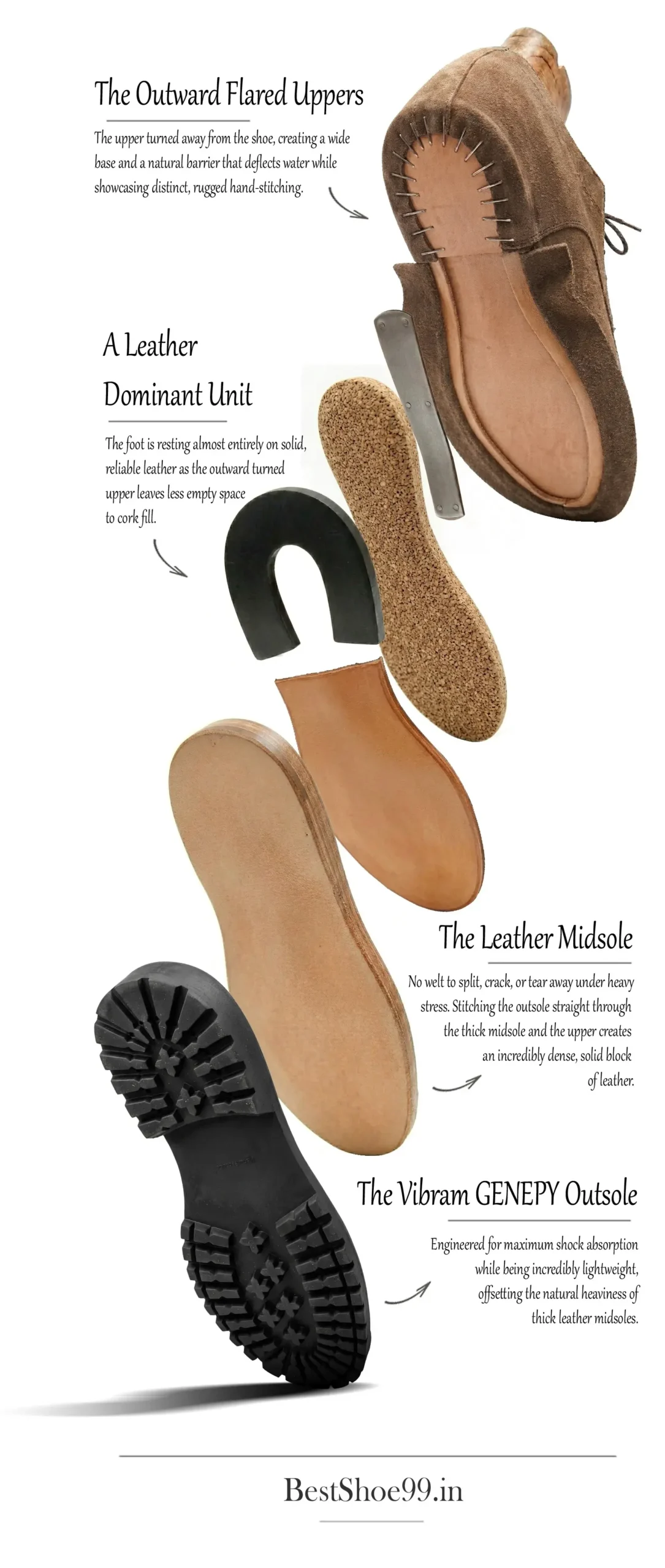
It is far more solid; braided linen threads are stitched through a thick leather insole rather than a canvas rib. Thus, all the aforementioned non-gemming construction benefits come standard in this Norwegian-stitched Aurora derby.
That and each layer of the sole assembly is anchored by distinct stitching—first passing through the outward-tucked upper, and then connecting sequentially to the layer over it. Due to outward flare, this Norwegian derby has a wider platform, which results in a much more secure and planted base.
Okay! But why isn’t the heel area sewn?
The outward flare in the back area can weaken the heel’s hold, make it look ugly, and make it difficult to execute.
If my years of trying shoes have taught me anything, it’s that few things make a shoe fit better than a firm heel hold—The Heel Counter. To prevent slippage, a rigid heel counter—typically made of plastic, or leather in premium footwear—is integrated into the back of the shoe.
Folding that thick, reinforced heel counter outward at a sharp 90-degree angle, smoothly and evenly without ugly bunching, is very difficult. Even then, stitching horizontally through the out-turned upper, the stiff heel-counter, and the thick leather insole while navigating the tight, vertical curve of the heel cup is incredibly awkward.
Even after taking that plunge, a 360-degree Norwegian shoe creates a pronounced ledge around the heel, which, in the front, looks rugged and protective but can make the heel area look incredibly wide and bulky.
Because of such structural, technical, and aesthetic reasons, the heel area is tucked tightly inwards, and the heel is attached through heavy-duty mechanical fastening.
A Heel Rand (horseshoe-shaped strip of leather) is glued to bridge the drop in thickness caused by the outward tucked upper. A solid premade block of rubber can be glued to this Heel Rand to finish the job quickly and to avoid the very risky task of trimming.
But BLKBRD, instead, stacks and attaches layers of leather to this Heel Rand through a row of brass nails straight through the solid leather insole, creating a permanent bond. The edges are trimmed very close to the upper, giving the Aurora derby a very sleek and beautiful heel.
Compared to the rubber heel block, the stacked leather heel possesses elasticity and compressed “give,” which significantly reduces foot fatigue over a long day of walking.
The Shape & Design
Everything is predominantly timeless and traditional, but they are keen to portray bold, angular, aggressive profiles.
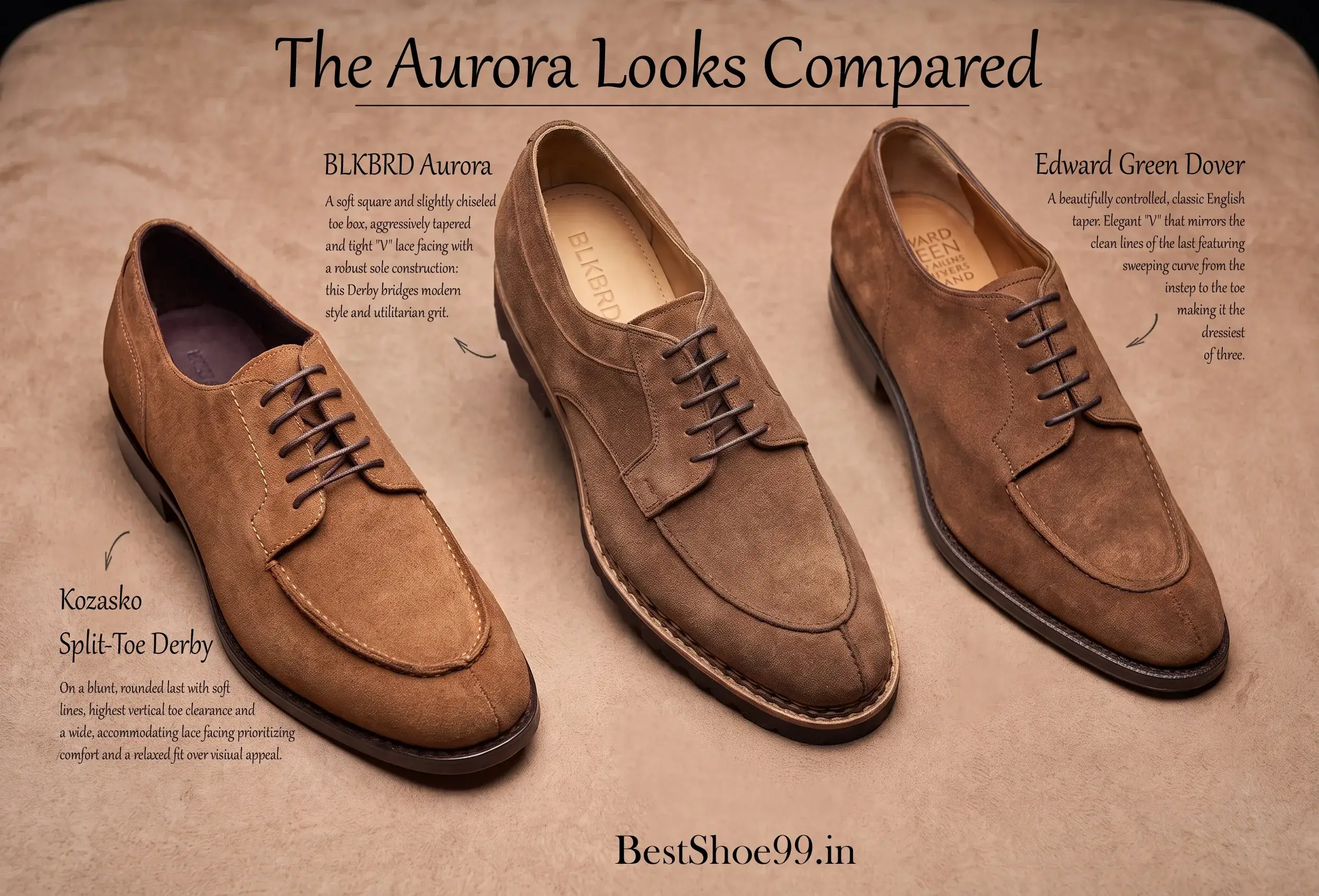
This—the design and shape segment—is a very subjective attribute to view dress shoes. Moreover, these attributes defy verbal explanation and demand to be seen—and experienced—in person.
I place the pair alongside other shoes, using contrast to reveal the true soul of their design and silhouette. What BLKBRD develops and carries in its overall design and shape philosophy is quite different from its competitors, who mostly do a very specific house style.
Fortunately, or rather, unwittingly, the two BLKBRD pairs I have showcase the label’s very distinct design principles.
The Aurora Derby, design and proportions-wise, is done very conservatively, and because most good shoemaker (in India) succumbs to it—this conservative theme—to a greater or lesser extent, I have a few pairs to benchmark them against.
Based on BLKBRD’s most refined Oceanco last, the Aurora acquired its soft classic almond toe shape, which, in my opinion, is the best body to such an apron “seam” or this kind of split toe.
The pattern pieces and proportions are beautifully balanced, handling the bulkier Norwegian constructions without looking clumsy. And because it is hand-lasted (manually pulling the damp upper leather over a foot model, called a last), the upper reflects the shape substantially.
It curves beautifully inward at the arch, but the outside of the derby looks flatter and “plain.” That asymmetry looks odd on a derby, but I admit, any curves on the outside sometimes do not leave enough room to work with difficult feet.
The subtly elongated profile keeps this derby from looking stubby or overly bulky. It’s plenty of vertical clearance is not something I feel strongly about, as this depth is barely noticeable when looking from the top, but it ensures the shoe won’t get pinched while walking. The (hand) stitching is, surprisingly, very consistent and fine.
Despite having all the fundamentals of a hand-lasted upper, the split suede shows the shape of the last significantly less because it is made of tiny raised fibers that absorb and diffuse light (rather than reflecting it), thus visually “blurs” the dramatic curves, slopes, and lines of the last.
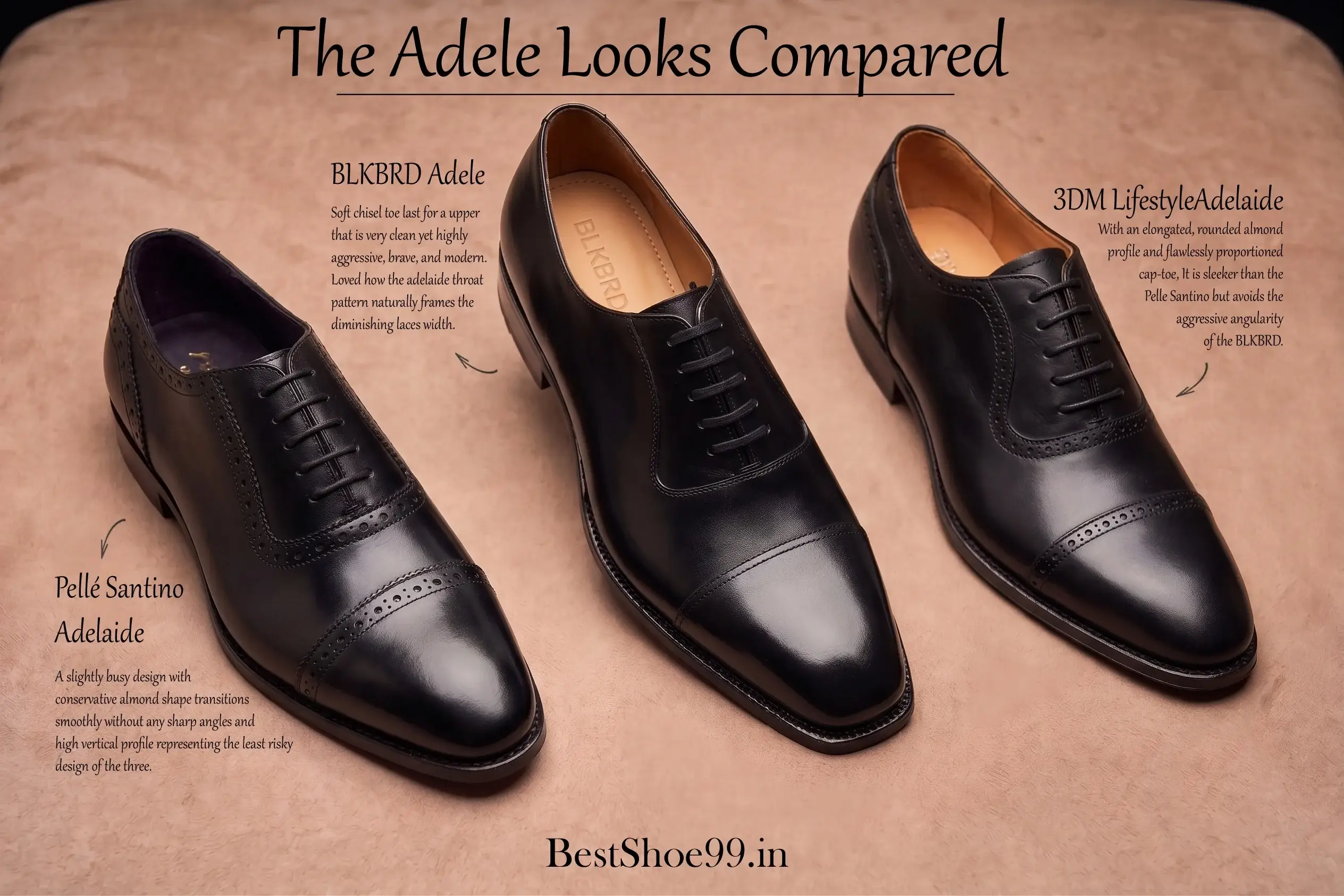
But that’s not the case with the Adele Oxford. Partly because of the material differences—smooth hand-lasted leather highlights the sharpest ridges of the shoe and casts deep shadows in the recesses—and further due to BLKBRD’s aspiration to dress it in an aggressive, angular, and cold attire.
The Adele Oxford is crafted on BLKBRD’s FF4 last. A heavily sculpted, razor-sharp last featuring high-tension ridges, square chisel toe, sucked-in waist, and curves in many places.
A heavily structured and sculpted last comes with a commercial risk of lacking enough room to accommodate many foot shapes, but it embeds an architectural look that such a plain Oxford would otherwise lack.
Plain because the Adele is a Cap-toe Adelaide Oxford. Instead of extending down to the sole, the stitching forms a U-shaped “throat” around the eyelets, leaving the quarters completely smooth.
When there is nothing to distract the eye, everything is in the last. In any setting, the Adele Oxford stands out immediately—not as much ’cause of its material or make, but through the three-dimensional geometry, which looks sophisticated compared to standard round-toe formals.
That peculiarity is developed not through loud elements but by aiming for a look that is classic and tends to be unobtrusive.
Such shoemaking artistry can be taken for granted from BLKBRD because they have high-level hand-lasting, bottom-making, and design skills required to make the “holy grail” of technical difficulty: Seamless Oxford. This is a theme I’d explore in a separate article in the future.
What is the purpose of a fiddleback waist?
Far be it from me to dismiss the immense labor behind such premium bottom finishes as ‘unnecessary.’
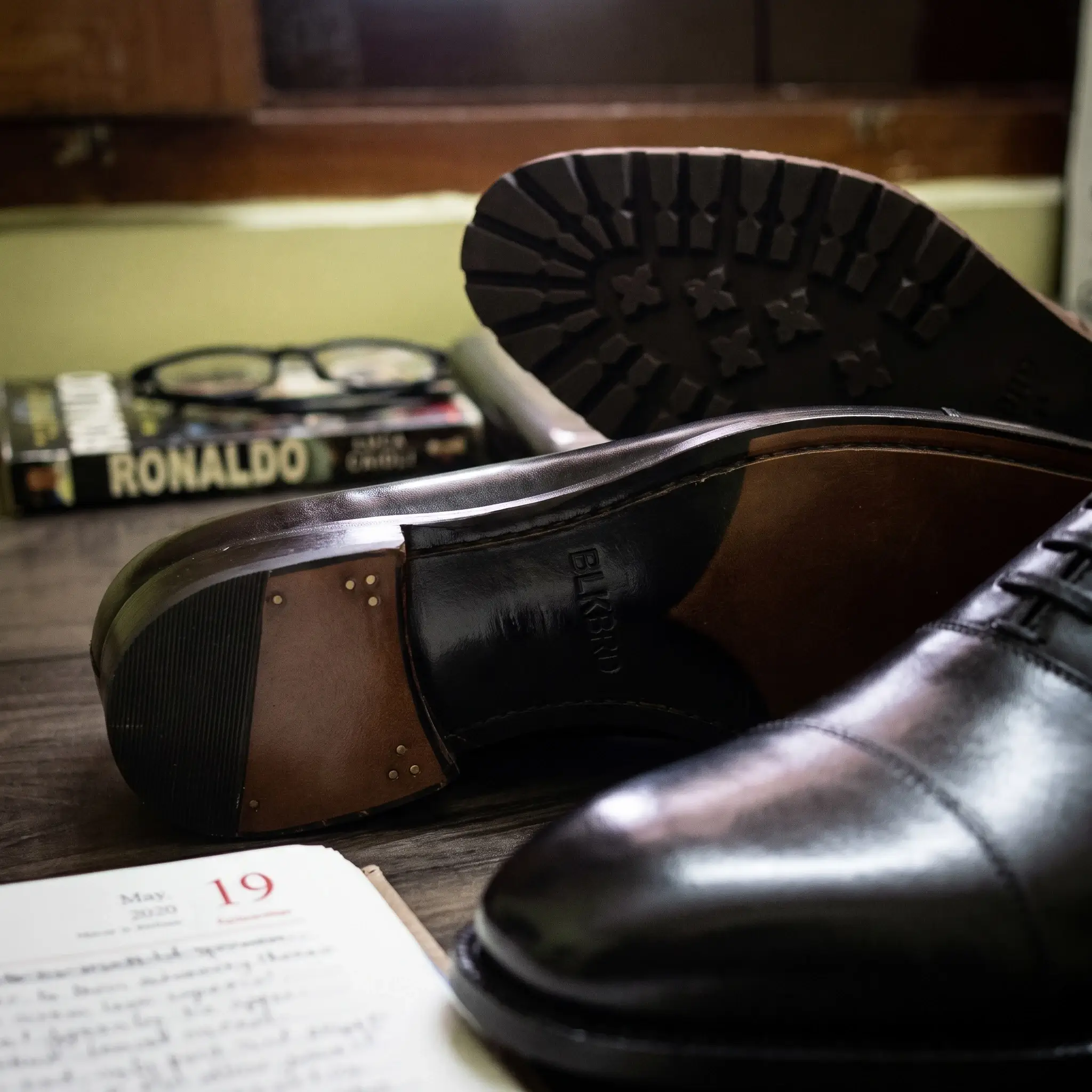
Let’s be brutally honest: that is a staggering amount of labor poured into that area of the shoe that was otherwise never seen by anyone other than you.
It is an angular treatment to the bottom of the shoe, which would otherwise remain flat and square. It starts from shaving and sculpting the layer of cork into a sharp, prominent ridge that splits into a Y-shape near the ball of the foot.
The damp leather outsole is then glued to the shaped bottom and gently hammered to form the leather around the contours of the Y-shaped ridge. Then it is sanded, dyed, and shined to highlight the violin-like shape.
Unless you are sitting cross-legged, nobody would ever notice this beautiful artwork. As it seems like BLKBRD isn’t charging extra for it, having a fiddleback waist is a zero-complaint luxury.
It is like the open caseback on a mechanical watch, often appreciated not for what it does, but for the sheer difficulty of how it was crafted.
The Fit & Comfort
Communicate about your foot and let them rightsize you.
As we expect from that much money, nothing less than excellence, high-end shoemakers have to “fit the mind as well as the foot”. That excellence, to a great extent, depends on how the shoe fits.
People vary in how they like shoes to fit, but don’t necessarily realise how they’re different. Considering such a personal viewpoint to abbreviate approximation is seen as a responsibility by BLKBRD, Bridlen, like shoemakers.
Ultimately, it all comes down to understanding your foot’s unique anatomy and articulating those details clearly to the shoemaker. That might not seem intuitive, because we are so accustomed to thinking about fit rationally and to describing it in terms of standard length-based sizes.
Your data is their only map, and trust me, BLKBRD is skilled at translating coordinates to a perfectly fitting shoe. You aren’t required to master everything about your foot’s highly irregular 3D landscape.
Articulating the length, width (both in centimeters), instep height, girth, and heel volume is enough for them to draw that satisfying fit. Avoiding heel slippage is the biggest challenge when a maker is doing remote fittings.
The Adele Oxford
I highly recommend staying true to size to ensure you have enough toe room.
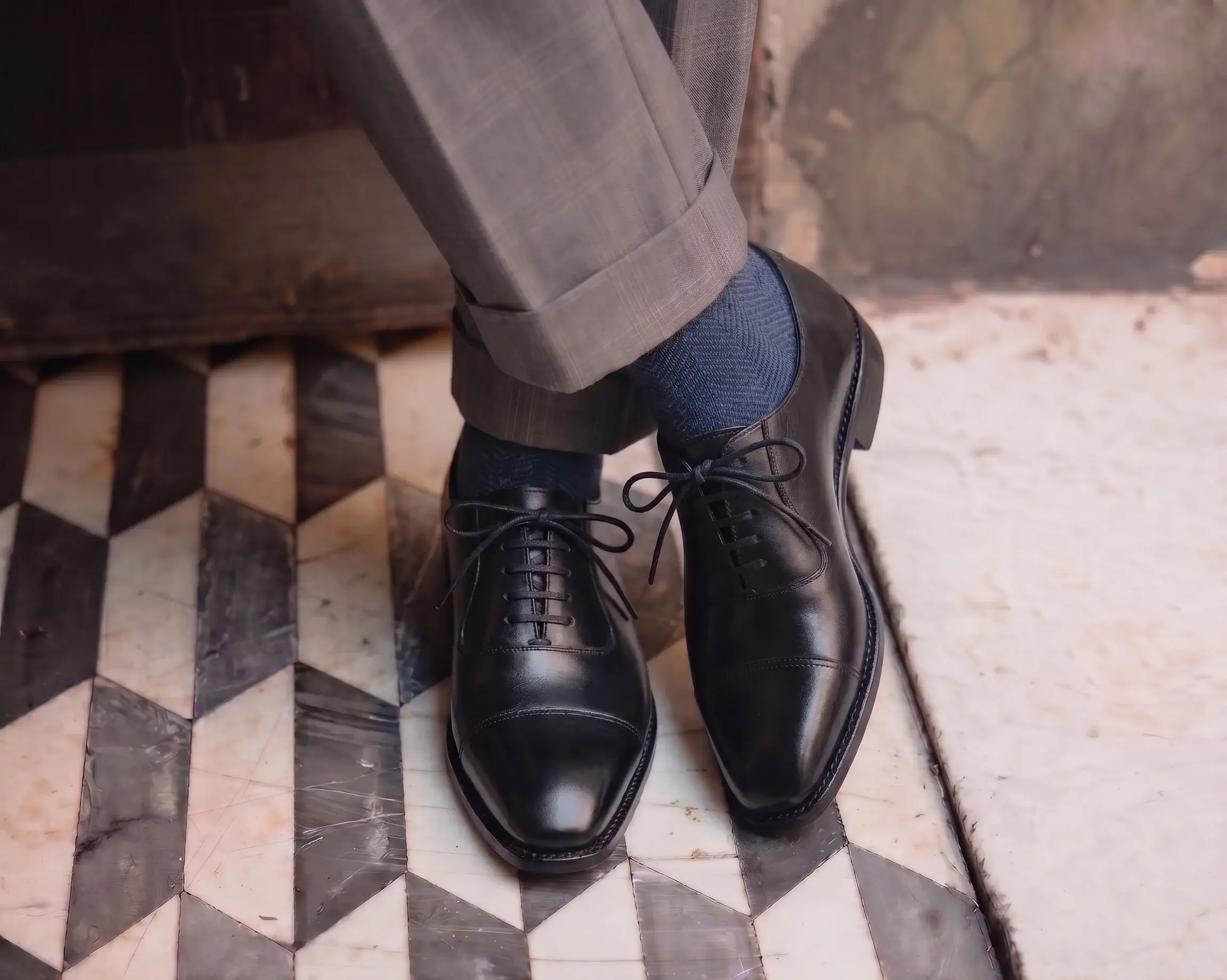
With a length of 26 cm, a width of 10 cm, and standard instep and heel (which typically aligns with a classic UK 7E), my foot dimensions fall right into a standard sweet spot.
Additionally, because I have prior experience with their Bobber and Cuero-B lasts, I could easily cross-reference the fit for this pair.
I have learned that by exercising this degree of caution—even with a standard foot shape—I rarely encounter a poor fit.
Despite its complex appearance, the Adele Oxford molded into a beautifully snug fit after a week of breaking in the solid soles.
Similar to Bridlen’s Rui last, the FF-4 last features a rising girth, which makes the interior spacious enough to achieve the highly coveted ‘V-gap’ closure, even with slightly higher insteps.
The grip from the suede heel lining helps to tackle the stiffness of a new shoe. It absorbs the movement and protects from blisters while the stiff structural leather gradually softens.
The chisel toe shape forces the shoe to narrow down so much earlier than a round almond toe last. Thus, those with wider feet might find the pinky toe or the side of the big toe gets compressed against the hard structural walls of the toe box.
For their FF-4 last, I highly recommend always believing in your true size to ensure enough elongated space ahead of the toe.
The Aurora Derby
Those with lower-volume or flat feet should consider sizing down.
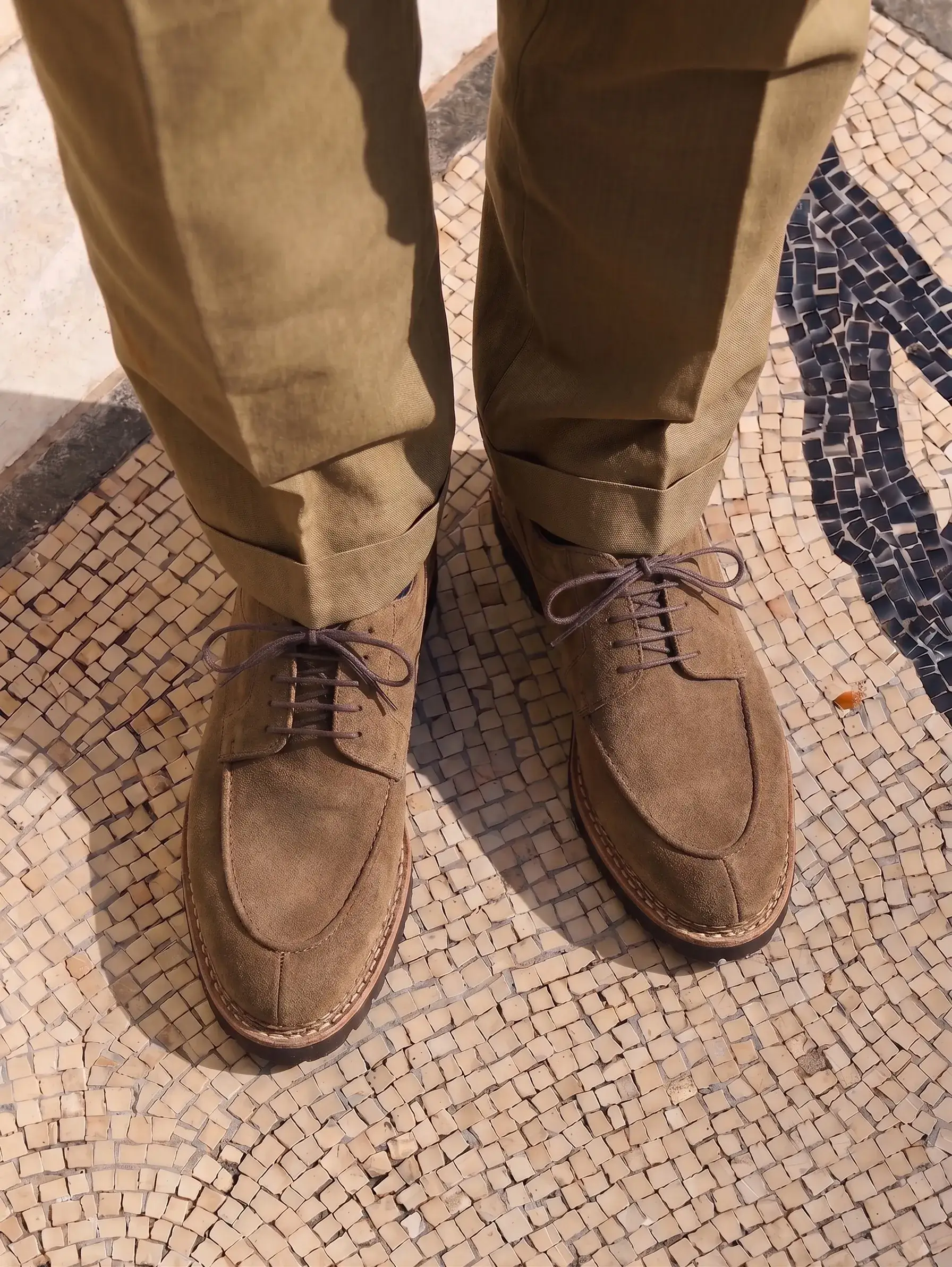
The Aurora Derby is naturally forgiving, and the classic almond-toed Oceano last underpinning its design eliminates any potential trade-offs.
Although I didn’t notice any issues with the Chisel toe, I have to agree that the almond shape of the Aurora tapers much more gently.
In the same way, the Adele Oxford didn’t lack the internal volume, but nothing is better than the freedom of adjusting the open lacing to fit the exact foot depth.
It has plenty of vertical clearance; thus, people with lower-volume or flat feet might be asked to size down mainly to avoid the panels’ overlap, especially around the top part, due to the diminishing width of the lacing as it goes up the tongue of the shoe.
The suede heel lining felt even more essential here, preventing the super-rigid sole from turning the heel into a blister zone. The arch does receive some support, as it is much more angular inside than the derby portrays.
Overall, the Adele Oxford could stand up on its own if one gets the fit just right, but the Aurora Derby would be much more comfortable.
How pleased I am with these BLKBRDs?
I don’t make money from your purchase, thus I can be entirely honest with you.
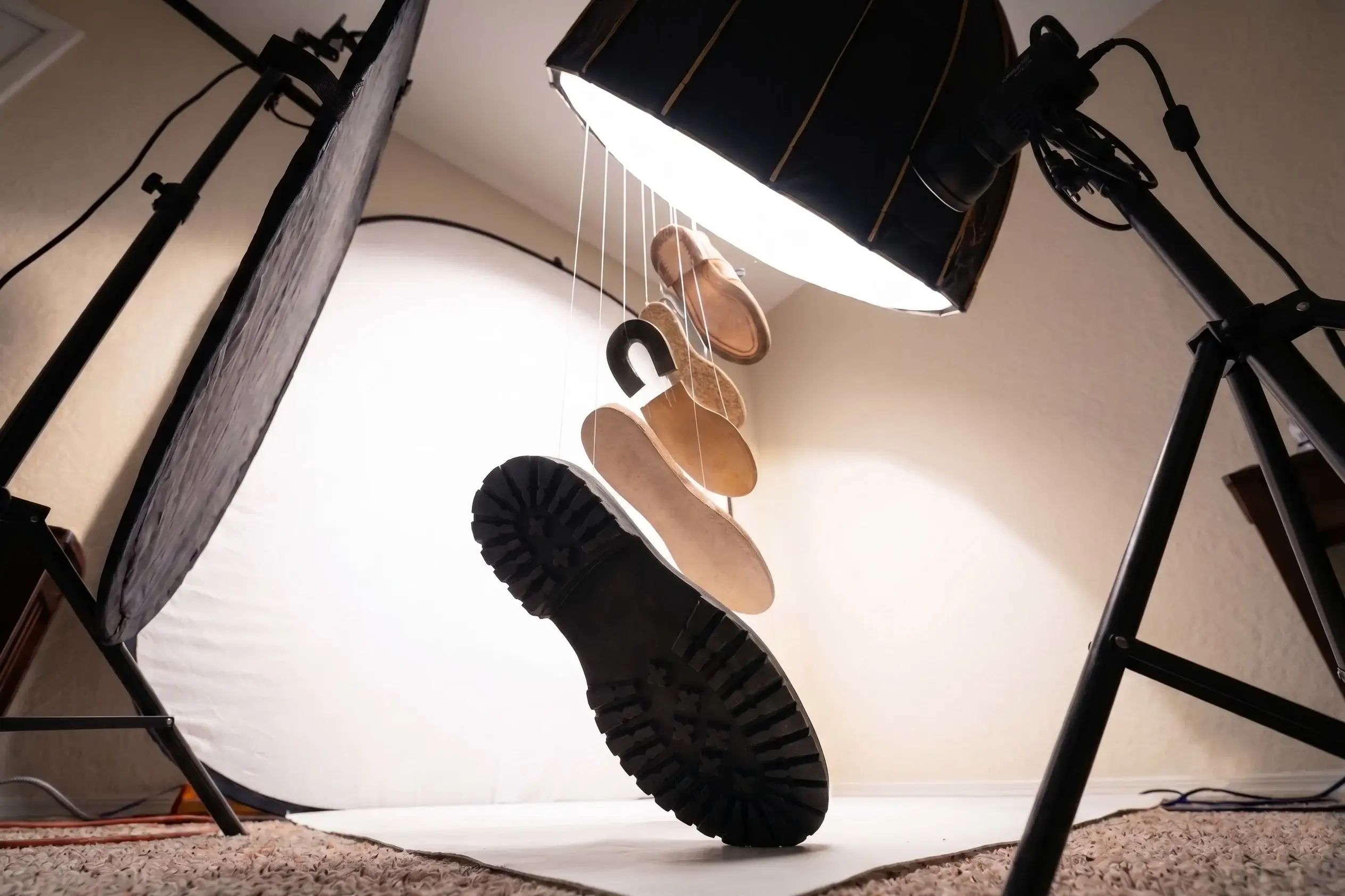
I don’t have any financial ties to BLKBRD, so I’m more than happy to share everything I’ve learned about their classic shoe lineup. ₹13,000 for a dress shoe, to non-native critics, such financial stakes feel incredibly low, and so it is hard for them not to deem BLKBRD as a great value shoe.
That money for me, and in anyone’s book, is a hefty purchase. Through the observations and sentiments that have formed over the three years I’ve had the Aurora and Adele, you might get a sense of who such shoes are for.
An expansion shoe, not a “one-and-done” starter!
The Adele Oxford assumes you already own the infrastructure required to care for it.
Approaching the BLKBRDs expecting something indestructible—and you’ll be disappointed. Expect an ever so slightly sharpened classic shoe—from what has mostly seen—, and you’ll discover a beguiling pair that never fails to feel and look special.
The Adele Oxford, for instance, is designed for strolling across the pavements of Golf links, the polished floors of Bengal Club, and the antique rugs of Soho House.
They will get you to the office and back every day, sure, but that razor-sharp ridge deserves more respect. The typical perception of shoes, I think, hasn’t been optimized or thought in a way that allows for appreciating high-caliber footwear.
Shoes like the Adele are a serious investment—one that needs equally serious consideration as well as a fair bit of knowledge. The extra money isn’t buying more years of durability than the standard Hush Puppies or Bata.
It is buying you finer details—compact construction and more dramatic shape—which, if used as a brutal daily starter, would strip away, without showing any long-term durability benefits.
It is worth having a pair like Adele if you have a rotation (three or two solid “workhorse”) to display the incredible artistry on the days it matters most, while staying pristine for years.
The material-to-construction match.
Please select an upper material for the Aurora derby that does justice to the ‘Norwegian’ make.
Someone has sold me the concept of Norwegian construction leading to the Aurora Derby: A pair I got wrong, largely because of the Suede quality.
I really wanted to explore this side of shoe construction—which I knew nothing about at the time—and the Aurora derby seems an affordable way to do it.
That early obsession gradually fades into the background, as the fuzzy nap of its split suede begins to pack down (smoothen), and it took me two years to accept that the Norwegian make is somewhat overpowered for its split suede upper.
This—the split suede upper—is not good enough to justify the strength, resoling advantage, and, eventually, the premium Norwegian construction carries.
Let’s be real, if we strip shoe construction methods back to their essence, remove their marketed persona, and look for what makes them meaningful, it all comes down to being a life-support system for the upper.
Good-quality upper materials can outlast several outsoles. Such uppers are the most expensive part, the only part that might have the potential to learn your foot, the part that, after years of decent care, reaches its aesthetic peak.
Such heirloom-like uppers deserve the extra work and money of those complex bottom-making techniques that allow for the replacement of a worn-out sole without sacrificing the integrity of the upper.
Unfortunately, that state of equilibrium between material and make is missing in the Split-Suede Aurora derby. I’m guessing this Split-suede will go well with a Blake construction. Anything beyond that is overengineering.
They produce the Aurora derby in higher-quality materials, such as Repello Calf Suede from CF Stead and Chestnut Museum Calf from Zonta. But I did what many guys do: if they like a concept, I chased the more exciting purchase over the more useful one.
Any better alternatives?
There are options but not without trade off(s). Check which are tolerable!
Radical authenticity is surging in the domain of Indian shoemaking. Makers are becoming braver and more willing to craft classic shoes using traditional methods.
However, it is expanding but not saturated. It is not brimming with options that makers are cannibalizing each other’s business. From distinct design languages to carving out identities based on their adopted constructions, every maker occupies a distinct niche.
Thus, the shoes recommended below are not identical clones of BLKBRD’s but scattered philosophies. I’ll tell you about their set of trade-offs, and you can migrate if those don’t align with your priorities.
Bridlen Blake Line
Nails the below ₹10k segment. It didn’t carry huge leaps, but it is solid in all areas.
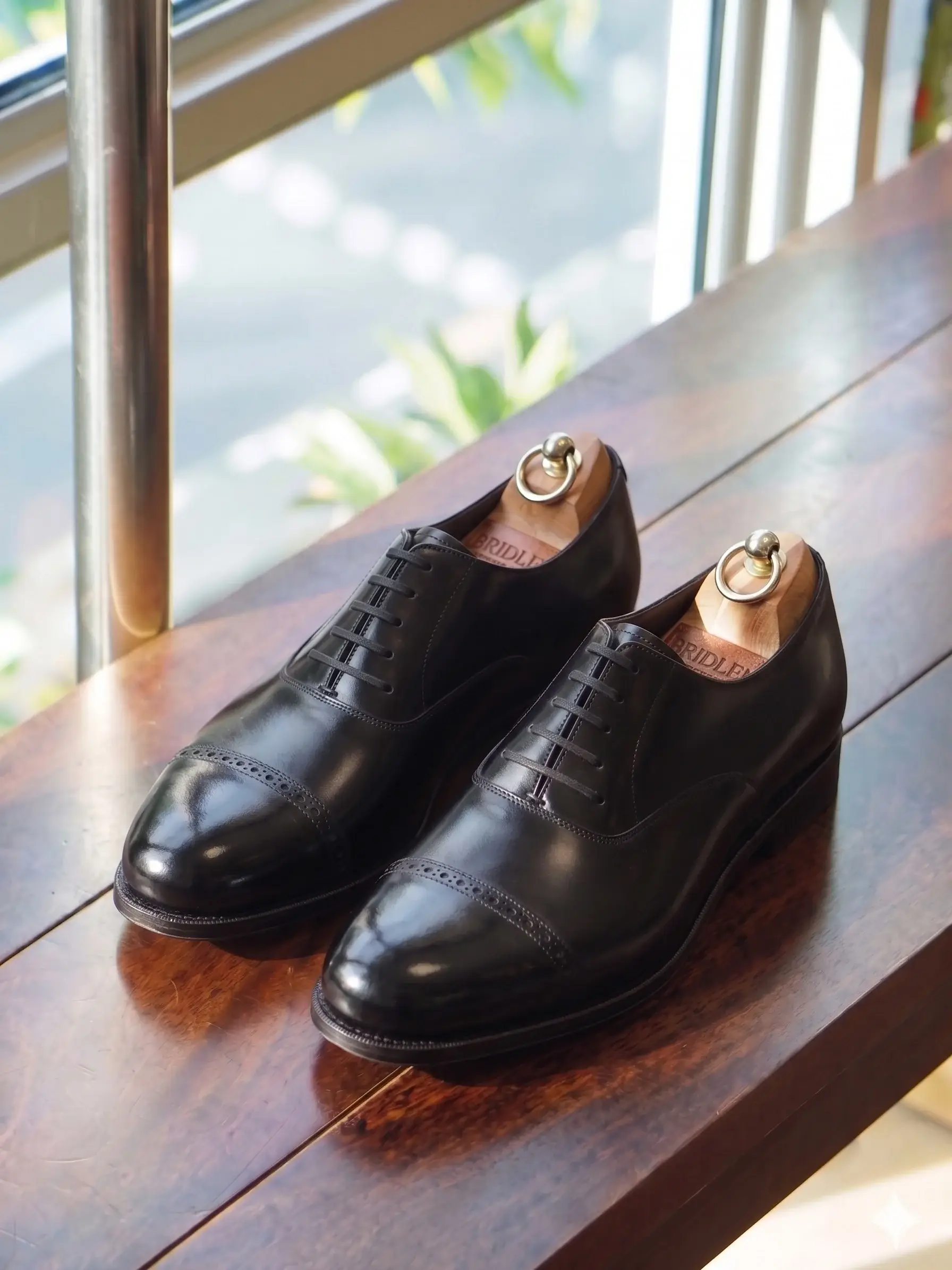
This one is tough to vanquish. Built on Blake-stitched, vegetable-tanned buffalo leather outsoles, the shoe features a premium full-grain tropical box-calf upper, drum-dyed crust leather lining, and a thick vegetable-tanned leather insole.
At ₹9,250 (hiked from ₹7,250), Bridlen Blake is obviously not cheap. But the mentioned elements make it worthy in a way that will annoy (M)any makers trying to compete in the same (if not higher) bracket.
Bridlen offers some of the most attainable calf-leather shoes on the market. By streamlining manufacturing and operating as an OEM (white-label manufacturer) for other brands, they buy leather in massive quantities.
This volume gives them the unique leverage to cherry-pick the absolute best cuts for their own house line. Shape, unfortunately, is not this design gem’s strongest suit.
I got a Blake-stitched pair from Bridlen five years ago and have been happily wearing them for the past two. I have written a separate article detailing my experience with them, which I highly recommend checking out before weaning away from these sharply shaped BLKBRDs.
Kozasko Welted Shoes
The two-year warranty. It is the thing almost everyone else misses.
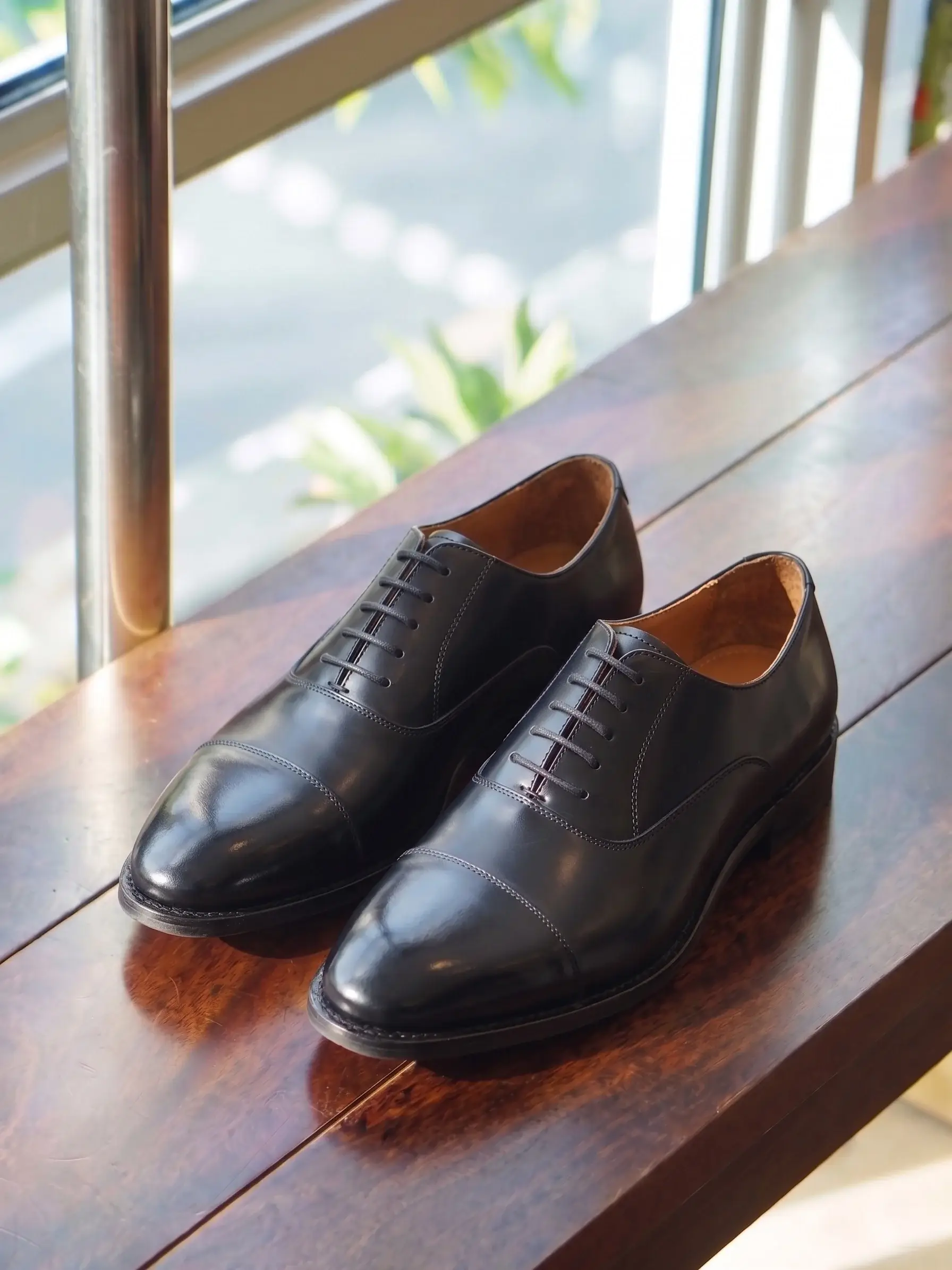
One could construe Kozasko Welted shoes as a match for BLKBRD formals. They pair a thoughtful design sensibility with elevated materials like box calf and roughout suede, matching them with the skill to handwelt in a clean, consistent rhythm—all at prices that will earn them enough to sustain their business.
There is a distinct relief in knowing you don’t have to tread lightly in Kozasko shoes; the makers’ faith in their product is so profound that they offer to repair or replace a pair up to two years old.
Their material and construction choices reflect how prepared (and pensive) they are to handle such claims. Shoes are crafted in either tough buffalo leather, roughout suede (for their entry-level options), or top-tier cold-weather calfskin—all featuring a thick insole and lining as standard.
I presume it is bloody difficult to get them seriously injured before that two-year mark. However, I wasn’t keen on finding out how difficult it would be.
I bought a pair of Kozasko (Oxford) eight months ago, which might be too early to write (separately) about them, but it’s enough to recommend.
Craft & Glory Welted Shoes
Practically skinned and stretched over their boot-like framework.
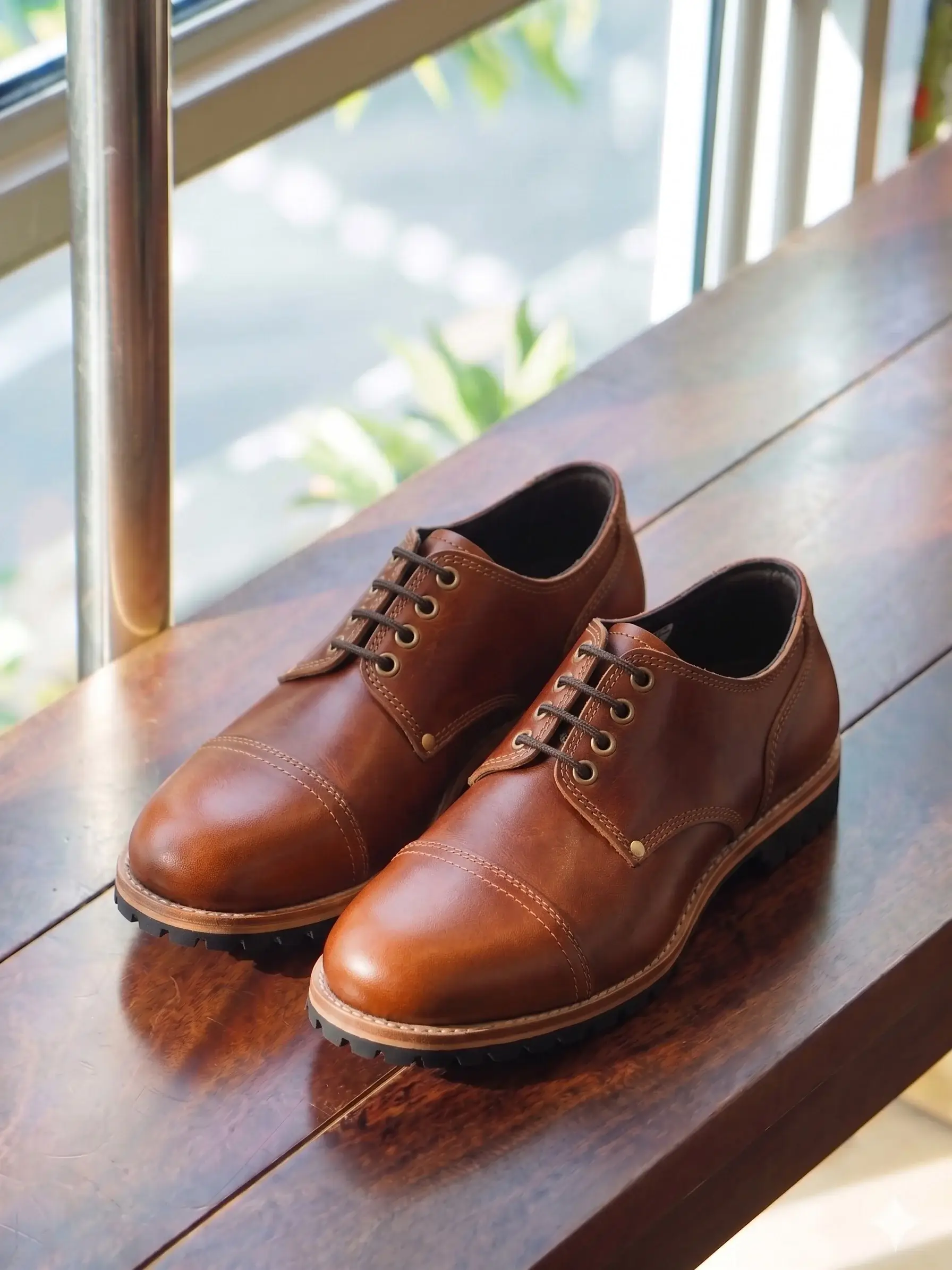
The most boot-minded maker ever to turn a dress shoe. For Craft & Glory, designing and executing a rugged Oxford and Derby isn’t a matter of how, but rather, which one.
Their Goodyear-welted pairs are neither complex nor compromising, very commercial and stiff. It may not be the last word in sophistication, but the thick full-grain buffalo leather upper doesn’t seek to pamper.
See, Craft & Glory is supposed to be for professionals—but outdoor kind. The one who spends their days navigating broken pavements, commuting trains in tough (but presentable) formals, and whose only shoe care is a quick rub down by the local mochi on the way to the office.
The Craft & Glory isn’t some delicate, red-bottomed pair to flaunt at the Bengal Club. It’s a tool.
You Might Also Like


How can we improve BestShoe99? Got feedback?